
Why Protecting Traditional Foods Protects Communities
CULTURAL INTELLIGENCE
Protecting traditional foods is about far more than preserving recipes - it is about safeguarding knowledge, identity, livelihoods, and the resilience of the communities that carry them forward.
By Yvonne Maffei • August 2026 • 10 min read

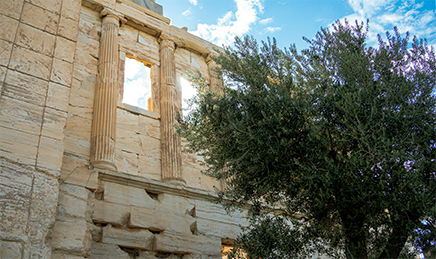
An olive grove overlooking the Mediterranean: A living landscape where agriculture, identity, and diplomacy have grown together for centuries.
Heritage Beyond Nostalgia
When conversations turn to traditional foods, they are often framed as matters of heritage or nostalgia. We speak of preserving recipes because they remind us of our grandparents, our childhoods, or places we once called home. While these memories are certainly worth cherishing, I have come to believe that protecting traditional foods is about something far more consequential than sentiment.
Traditional foods are living records of human knowledge.
Every regional cheese, loaf of bread, olive oil, spice blend, preserved fruit, or family recipe represents generations of observation, adaptation, and experience. Long before food scientists documented agricultural practices or universities established departments devoted to nutrition and sustainability, communities were learning from the landscapes around them. They understood when to plant, when to harvest, how to preserve abundance through changing seasons, and how to make the most of what the land could provide.
This knowledge was rarely written down.
Instead, it was shared around family tables, in village bakeries, in orchards, at fishing docks, and through countless ordinary conversations between parents and children. Skills were demonstrated rather than explained. Techniques were refined through repetition. Wisdom accumulated quietly over centuries until it became so familiar that many people no longer recognized it as expertise at all.
Traditional foods are, in many ways, libraries without shelves.
Food as Cultural Stewardship
When a traditional food disappears, we do not simply lose a recipe. We lose the agricultural practices that supported it, the local ingredients that gave it character, the seasonal rhythms that governed its preparation, and often the livelihoods of the people who kept those traditions alive. We also lose something less tangible but equally important: a community's confidence that what it has inherited is worth preserving.
Throughout the Mediterranean, I have seen remarkable examples of communities whose identities remain deeply intertwined with their local food traditions. Olive growers who can identify the subtle characteristics of trees planted generations before they were born. Cheesemakers who continue techniques learned from their parents and grandparents. Bakers who understand their local grains not through textbooks but through decades of daily practice. Fishermen whose knowledge of coastal waters reflects a lifetime of observation rather than satellite imagery.
These are not simply occupations. They are forms of cultural stewardship.
The foods they produce carry the stories of particular places. They tell us which crops thrive in certain soils, how families adapted to changing climates, what trade routes introduced new ingredients, and how communities balanced innovation with continuity. Each tradition becomes another chapter in the larger history of a region.
"These are not simply occupations. They are forms of cultural stewardship."
Protecting Knowledge Before It Disappears
Yet these traditions are increasingly vulnerable.
Global food systems have brought extraordinary benefits, making many foods more affordable and accessible than ever before. At the same time, they have also encouraged a degree of standardization that can unintentionally diminish local distinctiveness. Uniform varieties replace regional ones. Industrial production outpaces artisanal craftsmanship. Younger generations, understandably seeking economic opportunity, often leave rural communities where traditional knowledge has been cultivated for centuries.
None of this is a criticism of progress. Societies evolve, technologies improve, and food systems must continue adapting to meet the needs of growing populations. The challenge is ensuring that progress does not come at the expense of cultural knowledge that cannot easily be recovered once it is lost.
Protecting traditional foods, therefore, is not about resisting change. It is about recognizing value before it disappears.
This protection can take many forms. It may involve documenting recipes and oral histories before they are forgotten. It may mean supporting small producers who continue cultivating heritage varieties. It may encourage geographical indications that recognize the unique relationship between a product and the place from which it comes. It may inspire educational programs that introduce younger generations to the agricultural traditions that shaped their communities.
Perhaps most importantly, it begins with curiosity.
Community Resilience
When we ask where a food comes from, who produced it, how it has been prepared for generations, and why it matters to the people who make it, we participate in its preservation. We move beyond consumption and become students of culture. We begin to understand that every traditional food exists within an ecosystem of relationships connecting land, history, craftsmanship, family, and community.
I have often found that conversations about traditional foods quickly become conversations about resilience.
Communities that preserve their food traditions are rarely preserving ingredients alone. They are preserving local economies, regional identities, agricultural biodiversity, environmental knowledge, and social cohesion. Harvest festivals continue because they strengthen relationships between neighbors. Family recipes endure because they create continuity between generations. Local markets survive because they remain places where culture is exchanged alongside commerce.
In this sense, traditional foods contribute to something larger than cultural heritage. They contribute to community resilience.
Local Knowledge in a Global World
This has important implications for international development, sustainability, and even diplomacy. Communities that maintain strong cultural identities are often better positioned to participate confidently in global conversations without feeling that they must abandon their traditions to do so. Local knowledge becomes an asset rather than an obstacle. Heritage becomes a foundation for innovation instead of a relic of the past.
Throughout history, the Mediterranean has demonstrated that cultures flourish not by isolating themselves from one another but by sharing ideas while remaining deeply rooted in their own landscapes and traditions. Traditional foods have always been part of that exchange. They travel across borders, inspire new interpretations, and foster mutual appreciation, all while carrying the stories of the communities from which they originate.
There is, I think, a profound lesson in this.
Protecting People Through Food
The value of a traditional food cannot be measured solely by its market price or culinary reputation. Its true worth lies in the relationships it sustains: between people and the land, between generations within families, between neighboring communities, and between cultures that discover common ground through shared appreciation of one another's heritage.
Protecting these foods ultimately means protecting the people whose lives have shaped them.
It means recognizing that cultural heritage is not confined to museums or historical monuments. It exists in orchards that continue to bear fruit, in kitchens where recipes are still prepared by hand, in village markets where familiar faces gather each week, and in the quiet confidence of communities that know their traditions still have something meaningful to contribute to the world.
"When we choose to preserve traditional foods, we are not merely safeguarding the past. We are investing in the future of communities whose knowledge, resilience, and cultural richness continue to
nourish us all."
— Yvonne Maffei
CONTINUE THE CONVERSATION
Receive thoughtful essays exploring culture, diplomacy, food, and the Mediterranean world.
RELATED READING

What food has always known about building trust across borders.

CULTURAL INTELLIGENCE
How landscapes, traditions, migration, and memory shape not only what we eat, but who we become.
MEDITERRANEAN CIVILIZATIONS
A tree rooted in the soil of many nations, carrying centuries of peace, memory, and shared civilization.